Two years into a brutal civil war between the Sudanese Armed Forces and the paramilitary Rapid Support Forces, Sudan's information space has collapsed alongside much of its physical infrastructure. Security services on both sides of the conflict have turned social media posts into evidence for arrest, while journalists working online face abduction, violence, and disappearance. The result is a population increasingly unable to speak, document, or organize without fear of retaliation.
Speech Under Siege
Arrests tied to online expression have become a routine tool of control rather than an exceptional measure. Authorities have treated critical posts, shared images, and even private messages as grounds for detention, sending a clear signal that digital speech carries physical risk. For journalists reporting from conflict zones, the danger is more direct: RSF forces have been implicated in attacks, kidnappings, and enforced disappearances targeting those who document the war online. This pattern mirrors a broader trend seen in other conflict settings, where combatants treat independent reporting as a battlefield threat rather than a civic function.
The cumulative effect is a chilling one. When speaking out carries the risk of imprisonment or violence, self-censorship becomes a survival strategy. Sudanese users increasingly weigh every post, photograph, and comment against the possibility that it could be used against them or their families. This dynamic does not require a formal law to function; fear alone is sufficient to suppress dissent and narrow the flow of independent information from the ground.
Infrastructure as a Weapon
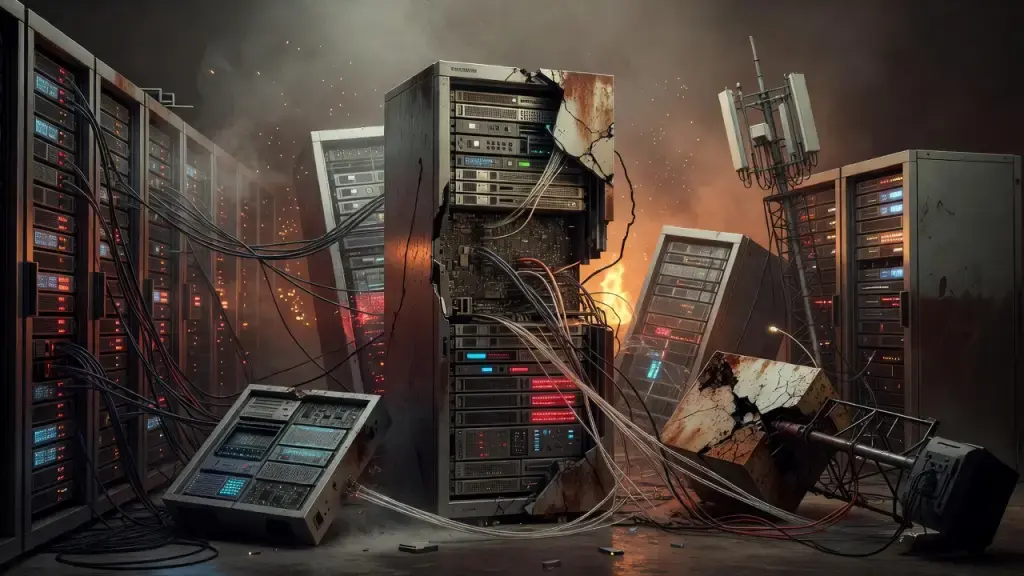
Beyond targeted repression, the war has physically damaged the networks that carry Sudan's internet traffic. Fiber lines, data centers, and telecommunications facilities have been damaged or destroyed amid fighting, while deliberate disruptions have cut off entire regions at critical moments. Internet blackouts of this kind are not incidental; they function as instruments of control, limiting the ability of civilians to coordinate aid, contact relatives, or alert the outside world to atrocities as they unfold.
The humanitarian cost is severe. Aid organizations depend on connectivity to assess needs, move resources, and communicate with communities in crisis. When networks go dark, that coordination breaks down precisely when it matters most. Equally significant is the loss of documentation: without reliable internet access, residents struggle to record and transmit evidence of attacks on civilians, war crimes, and mass displacement - material that has historically been essential for accountability efforts and international response.
What Connectivity Still Allows
Even where networks remain partially functional, Sudanese users operate under constant surveillance risk, making tools that obscure identity and encrypt communication more than a convenience. Virtual private networks and encrypted messaging cannot restore destroyed infrastructure or prevent arrests based on informant networks, but they can reduce the chance that ordinary online activity is intercepted or traced back to an individual. In a context where metadata alone can implicate a person, the gap between having internet access and having safe internet access has rarely been more consequential.
Sudan's experience illustrates a pattern now familiar across conflict zones worldwide: control over information infrastructure has become as strategically important as control over territory. As the war continues, the country's digital isolation is likely to deepen the humanitarian emergency, obscure the full scale of civilian suffering, and complicate any future effort to hold perpetrators accountable.