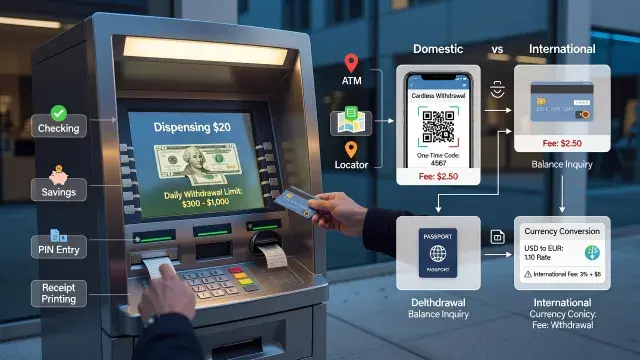
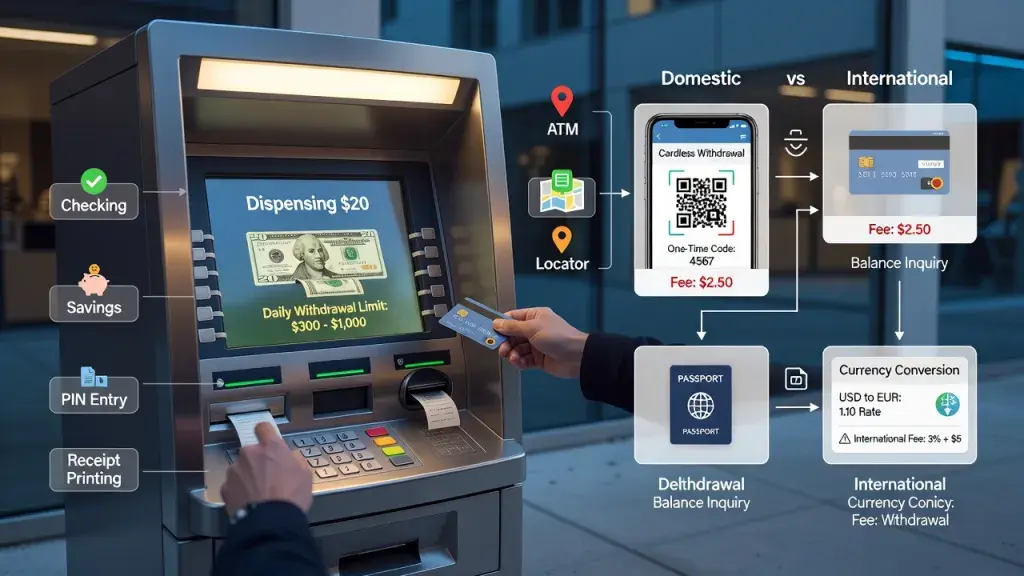
A standard ATM in the United States dispenses cash in $20 bills and caps most daily withdrawals somewhere between $300 and $1,000, depending on the bank and the account tier. Few people ever check that number until they're standing at a machine, card in hand, staring at a rejected transaction during a trip or an emergency. The mechanics of pulling cash from a bank account feel so routine that most of us never learn the actual rules governing them - until those rules cost us money or block access at the worst possible moment.
This gap in knowledge matters more than it seems. Daily limits, foreign transaction fees, dynamic currency conversion traps, and the newer world of cardless withdrawals all interact in ways that aren't obvious from the ATM screen alone. Anyone who wants to understand how to withdraw money on ATM machines efficiently - or avoid losing a percentage of every withdrawal to hidden charges - needs a clearer picture than what's printed on the receipt. For a more detailed breakdown of the process, resources like how to withdraw money on ATM can walk through the exact screens and confirmation steps involved, which is useful for anyone unfamiliar with a specific bank's interface. The goal here is to cover the full landscape: physical cards, cardless technology, fee structures, and the added complexity of withdrawing cash abroad.
What follows is a practical walkthrough built for anyone who wants to withdraw cash correctly, cheaply, and without surprises - whether at a corner ATM or a currency exchange counter three time zones from home.
Understanding the Basics of Cash Withdrawal
What Counts as a Cash Withdrawal
A cash withdrawal is any transaction that converts a balance held electronically - checking, savings, or sometimes a prepaid account - into physical currency handed to the account holder. This happens at ATMs, bank teller counters, and increasingly through point-of-sale cash-back options at retail checkouts. Each method draws from the same underlying balance but triggers different fee structures and processing paths behind the scenes.
Debit Cards vs. Credit Cards at the ATM
Debit cards pull directly from a linked bank account, so a withdrawal simply reduces an existing balance. Credit cards work differently: an ATM cash withdrawal on a credit card is treated as a cash advance, which usually accrues interest immediately with no grace period and often carries a separate, higher fee than a purchase would. This distinction trips up plenty of travelers who assume all plastic behaves the same way at a cash machine.
Why Withdrawal Methods Have Multiplied
Ten years ago, the choice was simple: insert a card or walk into a branch. Now banks offer mobile-app-generated codes, QR-based authentication, and biometric verification at select machines. This expansion exists because banks want to reduce card skimming exposure and give customers more flexibility when a physical card is lost, forgotten, or temporarily frozen.
How to Withdraw Money on ATM Machines
Step-by-Step Process
The sequence is largely standardized across banks and countries, even if screen design varies. Insert or tap the card, select a language if prompted, enter the PIN, choose "withdrawal" from the menu, select the account (checking or savings), enter the amount, and confirm. The machine then dispenses cash and, if requested, prints a receipt showing the remaining balance.
Choosing the Right Account and Amount
Many people default to withdrawing from checking without realizing some ATMs default to savings, or vice versa. Selecting the wrong account can trigger a decline if that account lacks sufficient funds, even when the total across both accounts would have covered the request. Entering an amount in round denominations ($20, $40, $60) also avoids errors, since most machines only dispense in fixed bill increments.
Common Errors and How to Avoid Them
Declined transactions usually stem from one of three causes: incorrect PIN entry, insufficient funds, or a daily limit already reached through earlier transactions that same day. A fourth, less obvious cause is a temporary hold placed by the bank's fraud detection system after unusual activity, such as a withdrawal in a new city. Contacting the bank directly, rather than repeating the attempt, resolves this faster.
- Verify the correct account is selected before entering an amount
- Keep PIN entry attempts to a minimum - three failed tries often lock the card
- Request a receipt to confirm the transaction and remaining balance
How to Withdraw Cash from Debit Card Beyond the ATM
Cash-Back at Point-of-Sale
Retailers such as grocery and drugstore chains often allow customers to request cash back during a debit purchase. This works by adding the withdrawal amount to the purchase total, charged as a single debit transaction, with the store handing over the cash from its own register. It's frequently fee-free, making it one of the cheapest ways to access cash without visiting an ATM.
Over-the-Counter Withdrawals at a Bank Branch
A teller can process a debit card withdrawal manually, which is useful when the amount needed exceeds the ATM's daily limit or when the card itself is damaged. This method typically requires photo identification and sometimes a signature matching bank records, adding a layer of verification absent from automated machines.
Mobile Banking Requests Before Arrival
Some banks let customers schedule a large withdrawal through their mobile app, which the branch then prepares in advance. This avoids having tellers count out unusually large sums on the spot and reduces wait times, particularly useful for withdrawals tied to real estate transactions or major purchases.
How to Withdraw Money on Cardless ATM Systems
How Cardless Technology Works
Cardless withdrawal relies on a temporary code generated through a banking app, paired with the phone's proximity or a manually entered number at the machine. Instead of a magnetic stripe or chip, the ATM authenticates the transaction through the code and, often, a secondary PIN entered on-screen. No physical card ever touches the machine.
Setting Up Cardless Access in Advance
Activation usually happens inside the bank's mobile app under a section labeled something like "ATM access" or "cardless withdrawal." Users select the account, generate a one-time code valid for a short window - often fifteen minutes - and then complete the transaction at a compatible machine before the code expires.
Security Advantages and Limitations
Removing the physical card from the equation eliminates skimming risk entirely, since there's no card to clone. The tradeoff is dependency on phone battery, signal, and app functionality - a dead phone means no access, whereas a physical card works regardless of connectivity. Cardless systems also remain less universal, so not every ATM network supports them yet.
Cash Withdrawal Fees and Limits Explained
In-Network vs. Out-of-Network Fees
Banks maintain partner ATM networks where withdrawals are free or discounted. Stepping outside that network typically triggers two charges: one from the ATM's operating bank and another from the customer's own bank, sometimes stacking to several dollars per transaction. Frequent travelers or those who move between cities often accumulate these fees without realizing how much they add up over a year.
Daily and Monthly Withdrawal Limits
Most banks impose a daily cap, commonly between $300 and $1,000, though premium account tiers sometimes raise this ceiling significantly. These limits exist primarily as a fraud-prevention measure - if a card is stolen, the damage is capped rather than open-ended. Some institutions also track a rolling monthly limit separate from the daily one, which can surprise customers making several large withdrawals in a short span.
How to Reduce or Avoid Fees
Choosing in-network ATMs, requesting cash back at checkout, or maintaining a premium account with fee waivers are the three most reliable tactics. Some banks also reimburse a limited number of out-of-network fees per month, a detail buried in account terms that's worth checking directly.
- Locate in-network ATMs through the bank's app before traveling
- Withdraw larger sums less frequently to reduce the number of fee-triggering transactions
- Review account terms for monthly fee reimbursement caps
International ATM Cash Withdrawal Steps
Preparing Before You Travel
Notifying the bank of travel dates and destinations prevents fraud algorithms from freezing the card the moment it's used abroad. It's also worth confirming whether the card carries a foreign transaction fee, typically a percentage of each withdrawal, separate from any ATM operator charge.
Navigating Currency Conversion Options
Foreign ATMs often ask whether the withdrawal should be converted at the ATM's rate or the bank's rate - a choice known as dynamic currency conversion. The ATM's rate is almost always worse. Declining the conversion and letting the home bank handle the exchange typically results in a better rate and lower overall cost.
Handling Declined Transactions Abroad
A card that works flawlessly at home can fail overseas due to chip compatibility issues, network restrictions, or a fraud flag triggered by the unfamiliar location. Carrying a backup card from a different bank, along with the institution's international support number, resolves most situations faster than waiting for a local branch, which may not exist in that country.
Recognizing Reliable ATMs Overseas
Machines attached to a bank branch are generally safer than freestanding ones in tourist areas, which sometimes carry higher fees or a greater risk of card skimming devices. Checking for tampering - a loose card slot, an unusual keypad overlay - takes seconds and prevents costly problems later.
Frequently Asked Questions
Why did my ATM withdrawal get declined even though I have enough money?
This usually happens when the daily withdrawal limit has already been reached through earlier transactions, or when the fraud detection system flagged unusual activity, such as a new location. Contacting the bank's support line directly clarifies the cause faster than repeating the attempt.
Is it cheaper to withdraw cash at an ATM or get cash back at a store?
Cash back at checkout is typically free, while ATM withdrawals outside your bank's network often carry two separate fees. For small amounts, cash back at a retailer is almost always the more economical choice.
Can I withdraw cash without my physical card?
Yes, through cardless ATM access set up in advance via the bank's mobile app, which generates a temporary code used at compatible machines. This method requires a working phone with battery and either signal or Bluetooth proximity, depending on the system.
Do credit cards work the same way as debit cards at ATMs?
No. A credit card withdrawal is treated as a cash advance, which usually starts accruing interest immediately and carries a separate fee, unlike a debit card withdrawal that simply draws from an existing balance.
Should I accept or decline currency conversion at a foreign ATM?
Decline it. The ATM's own conversion rate is almost always worse than the rate your home bank applies, so choosing to be charged in the local currency and letting your bank convert it later typically saves money.
What's the best way to avoid high fees while traveling internationally?
Withdraw larger amounts less frequently to minimize the number of fee-triggering transactions, use bank-branch ATMs rather than standalone tourist-area machines, and check whether your card offers reimbursement for foreign ATM fees before you leave.